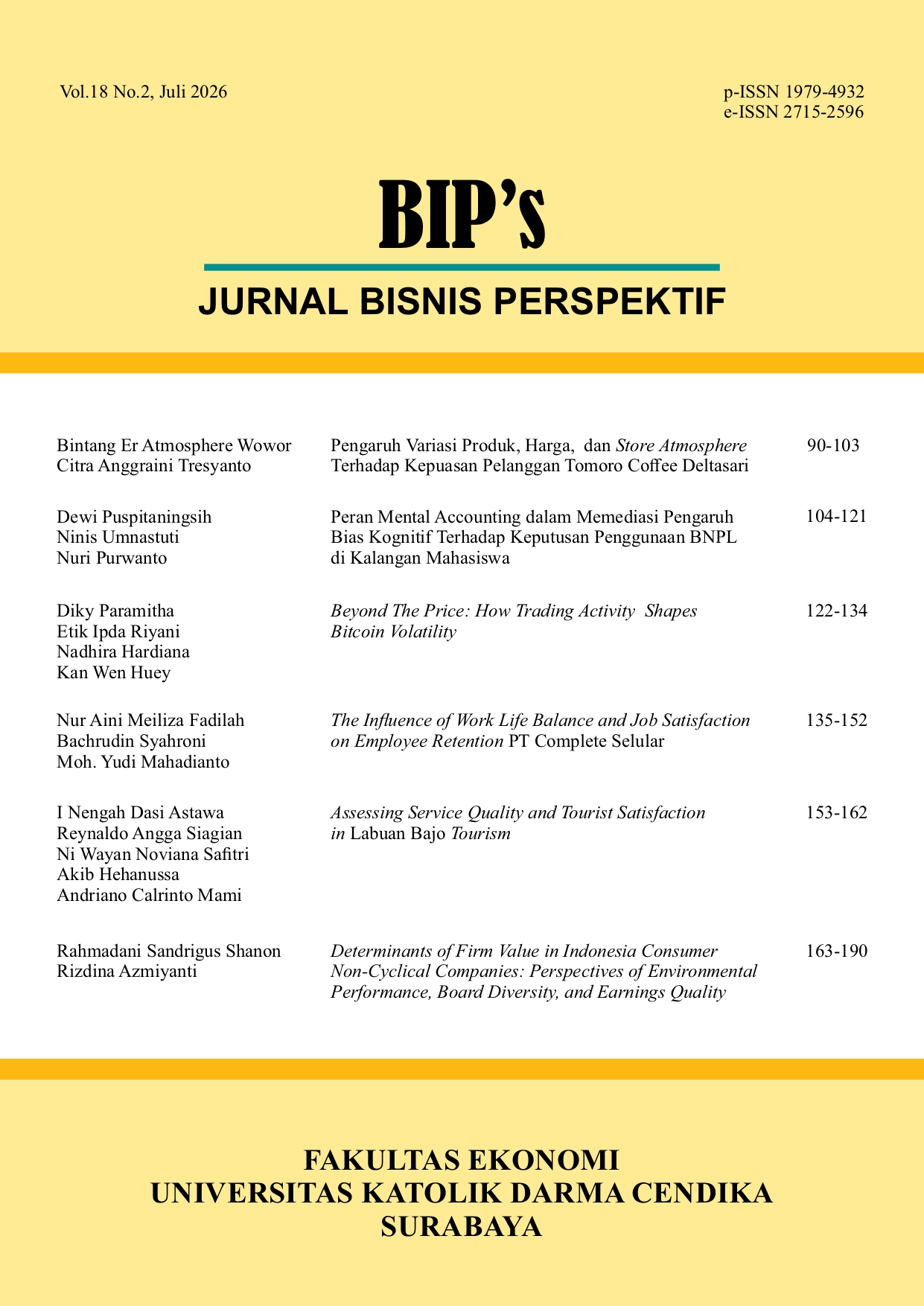
Assessing Service Quality and Tourist Satisfaction in Labuan Bajo Tourism
DOI:
https://doi.org/10.37477/bip.v18i2.933Keywords:
quality tourism, tourist satisfaction, emerging destination, sustainable tourismAbstract
This study examines the implementation of quality tourism and its relationship with tourist satisfaction in an emerging destination, focusing on tourism in Labuan Bajo, Indonesia. As a rapidly developing tourism destination, Labuan Bajo has been positioned as a strategic area that integrates natural attractions, tourism infrastructure, and sustainability-oriented development. However, empirical evidence on how quality tourism is perceived by visitors in emerging destinations remains limited. A quantitative descriptive approach was employed using a structured questionnaire with a five-point Likert scale. The study involved 200 respondents representing various stakeholders, including tourists, government, business actors, academics, and media. The analysis covered key dimensions of quality tourism, namely attractions, activities, amenities, accessibility, sustainability, environmental conditions, marketing, services, occupational health and safety, and overall tourist experience. The findings reveal that overall tourist satisfaction is categorized as very high, with an average score of 4.41. Natural attractions and service quality are identified as the main strengths of the destination. However, several aspects, including activity diversity, supporting facilities, accessibility for vulnerable groups, and community involvement, still require improvement. These results indicate that while Labuan Bajo has successfully delivered a positive tourism experience, further efforts are needed to enhance inclusiveness and long-term sustainability. This study provides empirical insights into quality tourism in emerging destinations and offers practical implications for destination managers and policymakers in improving tourism quality and competitiveness.
References
Baker, D. A., & Crompton, J. L. (2000). Quality, satisfaction and behavioral intentions. Annals of Tourism Research, 27(3), 785–804. https://doi.org/10.1016/S0160-7383(99)00108-5
Buhalis, D. (2000). Marketing the competitive destination of the future. Tourism Management, 21(1), 97–116. https://doi.org/10.1016/S0261-5177(99)00095-3
Calzada, I. (2020). Smart city citizenship. Journal of Urban Affairs, 42(5), 735–752. https://doi.org/10.1080/07352166.2018.1499412
Carayannis, E. G., & Campbell, D. F. J. (2009). “Mode 3” and “quadruple helix”: Toward a 21st century fractal innovation ecosystem. International Journal of Technology Management, 46(3–4), 201–234. https://doi.org/10.1504/IJTM.2009.023374
Chen, C. F., & Chen, F. S. (2010). Experience quality, perceived value, satisfaction and behavioral intentions for heritage tourists. Tourism Management, 31(1), 29–35. https://doi.org/10.1016/j.tourman.2009.02.008
Chi, C. G. Q., & Qu, H. (2008). Examining the structural relationships of destination image, tourist satisfaction and destination loyalty. Tourism Management, 29(4), 624–636. https://doi.org/10.1016/j.tourman.2007.06.007
Echtner, C. M., & Ritchie, J. R. B. (1993). The measurement of destination image: An empirical assessment. Journal of Travel Research, 31(4), 3–13. https://doi.org/10.1177/004728759303100402
González-Rodríguez, M. R., Díaz-Fernández, M. C., & Pino-Mejías, R. (2019). The impact of environmental commitment on tourist satisfaction. Sustainability, 11(8), 2362. https://doi.org/10.3390/su11082362
Gunn, C. A. (1994). Tourism planning: Basics, concepts, cases (3rd ed.). Taylor & Francis.
ITDC. (2025). Survey Kepuasan Pelanggan Kawasan Golomori. Unpublished.
Kozak, M., & Rimmington, M. (2000). Tourist satisfaction with Mallorca, Spain, as an off-season holiday destination. Journal of Travel Research, 38(3), 260–269. https://doi.org/10.1177/004728750003800308
Leung, D., Law, R., van Hoof, H., & Buhalis, D. (2015). Social media in tourism and hospitality: A literature review. Tourism Management, 46, 120–141. https://doi.org/10.1016/j.tourman.2014.07.013
Liburd, J. J., & Edwards, D. (2010). Understanding the sustainable development of tourism. Tourism Recreation Research, 35(1), 9–18. https://doi.org/10.1080/02508281.2010.11081616
Middleton, V. T. C., & Clarke, J. (2001). Marketing in travel and tourism (3rd ed.). Butterworth-Heinemann.
OECD. (2020). OECD tourism trends and policies 2020. OECD Publishing. https://doi.org/10.1787/6b47b985-en
Oliver, R. L. (1997). Satisfaction: A behavioral perspective on the consumer. McGraw-Hill.
Prayag, G. (2009). Tourists’ evaluations of destination image, satisfaction, and future behavioral intentions. Journal of Travel & Tourism Marketing, 26(8), 836–853. https://doi.org/10.1080/10548400903358715
Stylos, N., Vassiliadis, C. A., Bellou, V., & Andronikidis, A. (2016). Destination images, holistic images and personal normative beliefs. Journal of Business Research, 69(2), 507–514. https://doi.org/10.1016/j.jbusres.2015.05.021
UNWTO. (2018). Tourism for development – Volume I: Key areas for action. World Tourism Organization. https://doi.org/10.18111/9789284419722
Xiang, Z., Du, Q., Ma, Y., & Fan, W. (2017). A comparative analysis of major online review platforms. Tourism Management, 58, 51–65. https://doi.org/10.1016/j.tourman.2016.10.001
Yoon, Y., & Uysal, M. (2005). An examination of the effects of motivation and satisfaction on destination loyalty. Tourism Management, 26(1), 45–56. https://doi.org/10.1016/j.tourman.2003.08.016
Downloads
Published
How to Cite
Issue
Section
License
Copyright (c) 2026 Reynaldo Angga Siagian, I Nengah Dasi Astawa, Ni Wayan Noviana Safitri, Akib Hehanussa, Andriano Calrinto Mami

This work is licensed under a Creative Commons Attribution-NonCommercial-ShareAlike 4.0 International License.
Authors publishing in this journal agree to the following terms:
- The author retains copyright and grants the journal rights of first publication with the work simultaneously licensed under a Creative Commons Attribution ShareAlike License License that allows others to share the work with acknowledgment of the author's work and initial publication in BIP's: Journal of Business Perspectives.
- Authors may include separate additional contractual arrangements for non-exclusive distribution of the published version of the journal (e.g., submit to an institutional repository or publish in a book), with an acknowledgment of the original publication in this Journal.
- Authors are permitted and encouraged to post their work online (e.g., in institutional repositories or on their websites) before and during the submission process, as it can lead to productive exchanges, as well as citations of previously published work.
Each author is expected to complete the copyright process with a document of the originality of the manuscript, the templated document is below:
7.png)