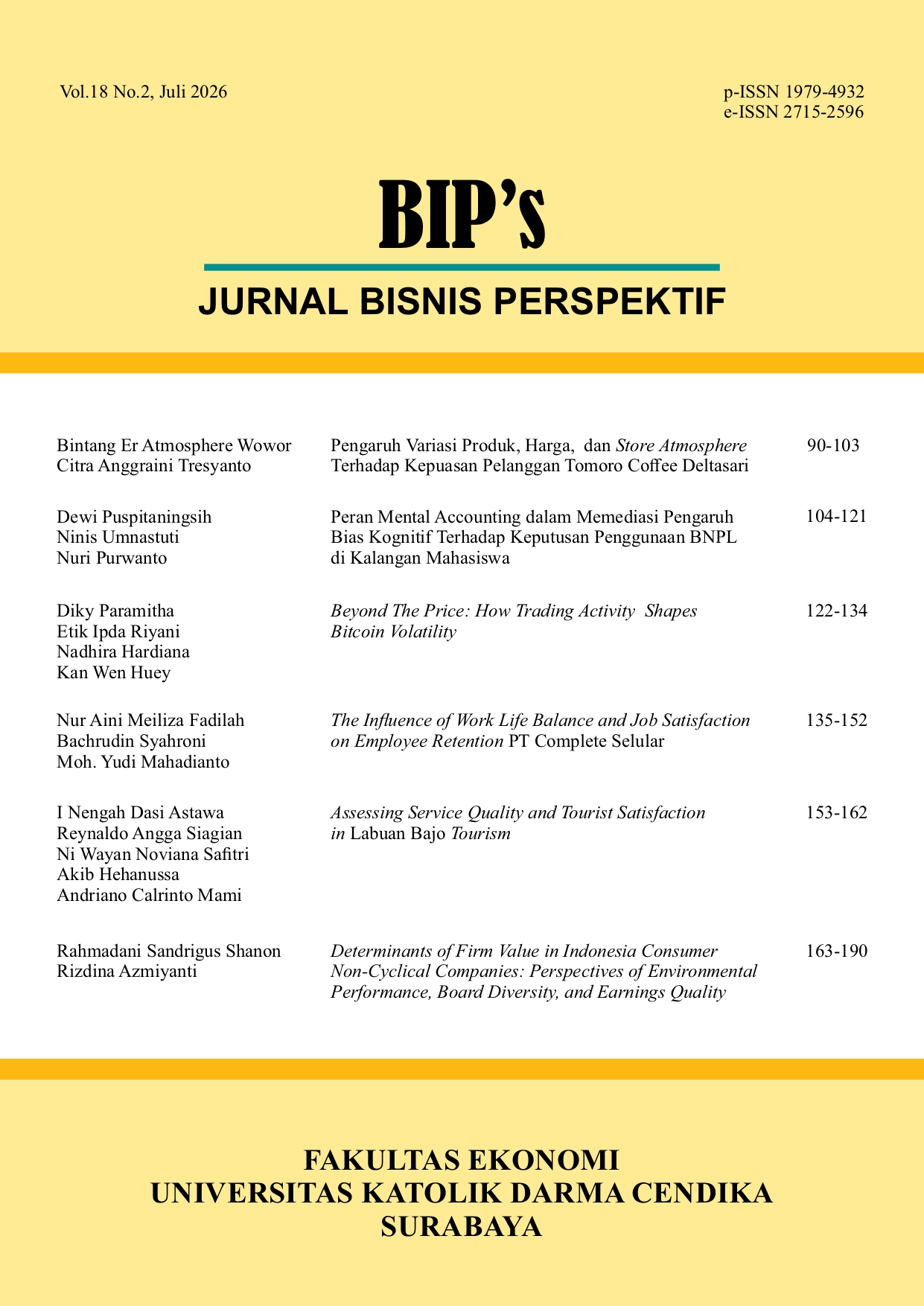
The Influence of Work Life Balance and Job Satisfaction on Employee Retention PT Complete Selular
DOI:
https://doi.org/10.37477/bip.v18i2.944Keywords:
employee retention;, job satisfaction;, work life balance;Abstract
This study aims to analyze the effect of work-life balance and job satisfaction on employee retention at PT Complete Selular, in response to the increasing concern of employee turnover and the need to identify key factors influencing employees’ intention to remain in the organization. This research employs a quantitative approach using Partial Least Squares Structural Equation Modeling (PLS-SEM) with data collected from 110 employees who meet the predetermined criteria. The results reveal that both work-life balance and job satisfaction have a significant effect on employee retention, with a high explanatory power indicated by an R-square value of 0.891, suggesting that 89.1% of the variance in employee retention is explained by the model. Specifically, work-life balance has a positive and significant effect (β = 0.313; p < 0.05), indicating that employees who are able to balance their professional and personal lives tend to have a higher intention to stay. Meanwhile, job satisfaction demonstrates a stronger and highly significant influence (β = 0.643; p < 0.001), making it the dominant factor affecting retention. These findings suggest that while work-life balance contributes to improving employees’ psychological well-being, job satisfaction plays a more critical role in determining retention decisions. Therefore, organizations are encouraged to adopt an integrated strategy by enhancing job satisfaction through supportive work environments, fair compensation, and effective management practices, while simultaneously maintaining work-life balance initiatives. This study contributes to the literature by providing empirical evidence from the Indonesian telecommunication distribution sector and offers practical implications for improving employee retention in similar organizational contexts.
References
Aguinis, H., & Kraiger, K. (2019). Benefits of training and development for individuals and teams, organizations, and society. Annual Review of Psychology, 60, 451–474, 60, 451–474. https://doi.org/https://doi.org/10.1146/annurev.psych.60.110707.163505
Akademik, S., Nakuru, K., & Bowen, D. (2024). RETENSI KARYAWAN UNIVERSITAS EGERTON Charity Nyangati Gundi1i Emily Chepsero Tumwet2 Abstrak : Penelitian ini menyelidiki pengaruh keseimbangan kerja-hidup terhadap retensi karyawan di retensi karyawan . Namun , penelitian ini juga menyoroti area yang menjadi perhatian , khususnya retensi karyawan di kalangan staf akademik . Temuan ini berkontribusi pada semakin banyaknya. 132–149. https://doi.org/10.46827/ejhrms.v8i1.1777
Allen, D. G., Bryant, P. C., & Vardaman, J. M. (2020). Retaining talent: Replacing misconceptions with evidence-based strategies. Academy of Management Perspectives, 24(2), 48–64. https://doi.org/https://doi.org/10.5465/amp.24.2.48
Allen, T. D., Herst, D. E. L., Bruck, C. S., & Sutton, M. (2023). Consequences associated with work-to-family conflict: A review and agenda for future research. Journal of Occupational Health Psychology, 5(2), 278–308.
Authors, F. (2016). Article information : Supervisor support and work-life balance : impacts on job performance in the Australian financial sector Abstract.
Bakker, A. B., & Demerouti, E. (2019). The job demands–resources model: State of the art. Journal of Managerial Psychology, 22(3), 309–328. https://doi.org/https://doi.org/10.1108/02683940710733115
Biron, M., & Boon, C. (2023). Performance and turnover intentions: A social exchange perspective. Human Resource Management, 52(4), 577–600. https://doi.org/https://doi.org/10.1002/hrm.21550
Boamah, S. A., Hamadi, H. Y., Havaei, F., Smith, H., & Webb, F. (2022). Striking a Balance between Work and Play : The Effects of Work – Life Interference and Burnout on Faculty Turnover Intentions and Career Satisfaction. 1–14.
Brough, P., Timms, C., O’Driscoll, M. P., Kalliath, T., Siu, O. L., Sit, C., & Lo, D. (2024). Work–life balance: A longitudinal evaluation of a new measure across Australia and New Zealand workers. The International Journal of Human Resource Management, 25(19), 2724–2744. https://doi.org/https://doi.org/10.1080/09585192.2014.899262
Cropanzano, R., & Mitchell, M. S. (2020). Social exchange theory: An interdisciplinary review. Journal of Management, 31(6), 874–900. https://doi.org/https://doi.org/10.1177/0149206305279602
David, J., Adimasta, B., & Lataruva, E. (2025). Work-Life Balance : The Key to Employee Engagement and Employee Performance. 9(1), 71–82.
Dea, R. F. Abrian, Y. (2025). The Influence of Work-Life Balance and Job Satisfaction on Turnover Intention Among Generation Z Employees. Https://Journal.Herphieducation.Com/Index.Php/Jomm/Article/View/56?Utm_source=chatgpt.Com.
Eisenberger, R., Huntington, R., Hutchison, S., & Sowa, D. (2022). Perceived organizational support. Journal of Applied Psychology, 71(3), 500–507.
Ekhsan, M., Ekonomi, F., Bangsa, U. P., Ekonomi, F., & Bangsa, U. P. (2024). Pengaruh Work-life Balance yang di Mediasi oleh Job Satisfaction terhadap Turnover Intention. 11(2), 100–112.
Excellence, B. (2016). Work-life balance , job satisfaction and nurses retention : moderating role of work volition Alamzeb Aamir * Abu Bakar Abdul Hamid Maqsood Haider and Chaudhry Shoaib Akhtar. 10(4), 488–501.
Greenhaus, J. H., & Allen, T. D. (2021). Work–family balance: A review and extension of the literature. In Journal of Management, 165–183.
Griffeth, R. W., Hom, P. W., & Gaertner, S. (2019). A meta-analysis of antecedents and correlates of employee turnover. Journal of Management, 26(3), 436–488. https://doi.org/https://doi.org/10.1177/014920630002600305
Gundi, C. N., Tumwet, E. C., & Bowen, D. (2024). Pengaruh Keseimbangan Kerja-Kehidupan Terhadap Retensi Karyawan Universitas Egerton Staf Akademik, Kabupaten Nakuru, Kenya.
Haar, J. M., Russo, M., Suñe, A., & Ollier-Malaterre, A. (2018). Outcomes of work–life balance on job satisfaction, life satisfaction, and mental health. Journal of Vocational Behavior, 85(3), 361–373. https://doi.org/https://doi.org/10.1016/j.jvb.2014.08.010
Hassan, A. G., Donianto, C. A., Kiolol, T. J., & Abd, T. M. K. (2024). PENGARUH TALENT MANAGEMENT DAN WORK-LIFE BALANCE TERHADAP RETENSI KARYAWAN DENGAN MEDIASI DUKUNGAN ORGANISASI.
Hom, P. W., Lee, T. W., Shaw, J. D., & Hausknecht, J. P. (2018). One hundred years of employee turnover theory and research. Journal of Applied Psychology, 102(3), 530–545. https://doi.org/https://doi.org/10.1037/apl0000103
Htun, W. . (2022). Employees Job Satisfaction and Retention at Workplace.
Ihwanudin, M., Manajemen, D., Ekonomi, F., & Airlangga, U. (2023). Pengaruh kualitas kehidupan kerja dan keseimbangan kehidupan kerja terhadap performa karyawan peran mediasi kepuasan kerja. 10.
Internasional, J., & Lingkungan, I. (2025). Machine Translated by Google Machine Translated by Google. 3, 64–74.
Jamalulel, I. Chang, C.-L. (2025). Work-Life Balance and Career Development: How Job Satisfaction Mediates Their Impact on Turnover Intention Among Indonesian Generation Z? Https://Publisher.Unimas.My/Ojs/Index.Php/IJBS/Article/View/8302?Utm_source=chatgpt.Com.
Judge, T. A., Thoresen, C. J., Bono, J. E., & Patton, G. K. (2021). The job satisfaction–job performance relationship: A qualitative and quantitative review. Psychological Bulletin, 127(3), 376–407. https://doi.org/https://doi.org/10.1037/0033-2909.127.3.376
Karolina, N. Saryatmo, M. A. (2024). Employee Engagement, Work-Life Balance, and Turnover Intention Among Generation Z Employees: The Mediating Role of Job Satisfaction. Https://Www.Journal.Untar.Ac.Id/Index.Php/Jmbk/Article/View/29657?Utm_source=chatgpt.Com.
Kerja, K., Kerja, K., Nandiatama, S., Isni, F., Amalia, L., & Anindita, R. (2022). Pengaruh Pembagian Waktu Kerja Terhadap Keseimbangan. 19(02), 68–83.
Ketapang, K. (2025). Jurnal Maneksi ( Management Ekonomi Dan Akuntansi ). 14(02), 659–670.
Konsep, J., Dan, B., Millenial, G., Mediasi, P., Nurdin, S., & Rohaeni, H. (2020). JKBM Work-Life Balance dan Dampaknya terhadap Intention Work-Life Balance and its Impact on Turnover Intention in the Millennium : the Mediation Role of Job Satisfaction. 6(2), 121–132.
Kossek, E. E., Pichler, S., Bodner, T., & Hammer, L. B. (2018). Workplace social support and work–family conflict: A meta-analysis. Journal of Applied Psychology, 96(2), 289–313. https://doi.org/https://doi.org/10.1037/a0022165
Kristinanda, D. K., & Priyatama, A. N. (2019). KEPUASAN KERJA SEBAGAI MODERATOR HUBUNGAN ANTARA WORK-LIFE BALANCE DENGAN EMPLOYEE ENGAGEMENT KARYAWAN GENERASI MILENIAL PT X JAKARTA. 1–6.
Lamane-harim, J., Cegarra-leiva, D., Sánchez-vidal, M. E., Lamane-harim, J., Cegarra-leiva, D., & Eugenia, M. (2021). Work – life balance supportive culture : a way to retain employees in Spanish SMEs Work – life balance supportive culture : a way to. https://doi.org/10.1080/09585192.2021.1878255
Mahadianto, M. Y., Setiawan, A., Salahudin, A., & Fatimah, S. E. (2017). Pengantar Statistik I. PT Penerbit IPB Press.
Margaret Deery Leo Jago. (2015). International Journal of Contemporary Hospitality Management. https://doi.org/http://dx.doi.org/10.1108/IJCHM-12-2013-0538
McNall, L. A., Masuda, A. D., & Nicklin, J. M. (2020). Flexible work arrangements, job satisfaction, and turnover intentions. Journal of Business and Psychology, 25(1), 61–81. https://doi.org/https://doi.org/10.1007/s10869-009-9144-8
Mohd, T., & Abd, K. (2022). PENGARUH TALENT MANAGEMENT DAN WORK-LIFE BALANCE TERHADAP RETENSI KARYAWAN DENGAN MEDIASI DUKUNGAN ORGANISASI. 34(2), 158–183.
Muhaimin, M. I., Fauzan, R., & Saputra, P. (2025). Jurnal Penelitian Nusantara Pengaruh Reward Dan Work-Life Balance Terhadap Retensi Karyawan Melalui Job Satisfaction Sebagai Mediasi Pada Generasi Z Di Coffee Shop Pontianak Menulis : Jurnal Penelitian Nusantara. 1, 169–181.
Muhammad, F. R., Siregar, M. Y., & Fatihaturrizqi, M. (2025). Work-Life Balance Sebagai Strategi Retensi Karyawan Milenial Dan Gen Z. 2(1), 20–27.
Nguyen, C., & Duong, A. (2020a). The Impact of Training and Development, Job Satisfaction and Job Performance on Young Employee Retention. 13.
Nguyen, C., & Duong, A. (2020b). The Impact of Training and Development , Job Satisfaction and Job Performance on Young Employee Retention. 13(3), 373–386.
Nurdin, S., & Rohaeni, H. (2020). Work-Life Balance dan Dampaknya terhadap Intention Turnover pada Generasi Millenial : Peran Mediasi Job Satisfaction.
Peters, P., Dulk, L., & Ruijter, J. (2019). May I work from home? Views of the employment relationship reflected in line managers’ telework attitudes. Employee Relations, 31(4), 416–431. https://doi.org/https://doi.org/10.1108/01425450910968277
Pradesh, A., Pradesh, A., Pradesh, A., Pradesh, A., Pradesh, A., & Principal, V. (2024). Abstract : 34(01), 276–286.
Sam, B., Lavanya, G., Srinivasu, P., Venkataswamy, G., Choudary, S. K., & Avala, C. (2024). Work-Life Balance, Job Satisfaction, and Employee Retention: A Triangular Approach.
Sidiq, S. A. Poerwita, S. F. (2025). Generation Z in the Workplace: How Work-Life Balance and Job Satisfaction Drive Turnover Intention in Indonesia. Https://Theaspd.Com/Index.Php/Ijes/Article/View/947?Utm_source=chatgpt.Com.
Soleha, N. Wulandaru, D. R. (2025). The Influence of Work-Life Balance on Turnover Intention with Job Satisfaction as a Mediating Variable Among Generation Z. Https://Journal.Unu-Jogja.Ac.Id/Fe/Index.Php/j-Fine/Article/View/34?Utm_source=chatgpt.Com.
Suprayitno, D. (2024). Assessing the Effect of Compensation Packages , Work-Life Balance Policies , and Career Development Opportunities on Employee Retention : A Case Study of MSME Employee. 5(2), 1592–1601.
Translated, M. (2022). Kepuasan Kerja dan Retensi Karyawan di Tempat Kerja. 6(3), 4342–4346.
Wong, K., & Chan, A. H. S. (2020). How Is Work – Life Balance Arrangement Associated with Organisational Performance ? A Meta-Analysis. Cm.
Downloads
Published
How to Cite
Issue
Section
License
Copyright (c) 2026 Nur Aini Meiliza Fadilah, Bachrudin Syahroni, Moh. Yudi Mahadianto

This work is licensed under a Creative Commons Attribution-NonCommercial-ShareAlike 4.0 International License.
Authors publishing in this journal agree to the following terms:
- The author retains copyright and grants the journal rights of first publication with the work simultaneously licensed under a Creative Commons Attribution ShareAlike License License that allows others to share the work with acknowledgment of the author's work and initial publication in BIP's: Journal of Business Perspectives.
- Authors may include separate additional contractual arrangements for non-exclusive distribution of the published version of the journal (e.g., submit to an institutional repository or publish in a book), with an acknowledgment of the original publication in this Journal.
- Authors are permitted and encouraged to post their work online (e.g., in institutional repositories or on their websites) before and during the submission process, as it can lead to productive exchanges, as well as citations of previously published work.
Each author is expected to complete the copyright process with a document of the originality of the manuscript, the templated document is below:
7.png)