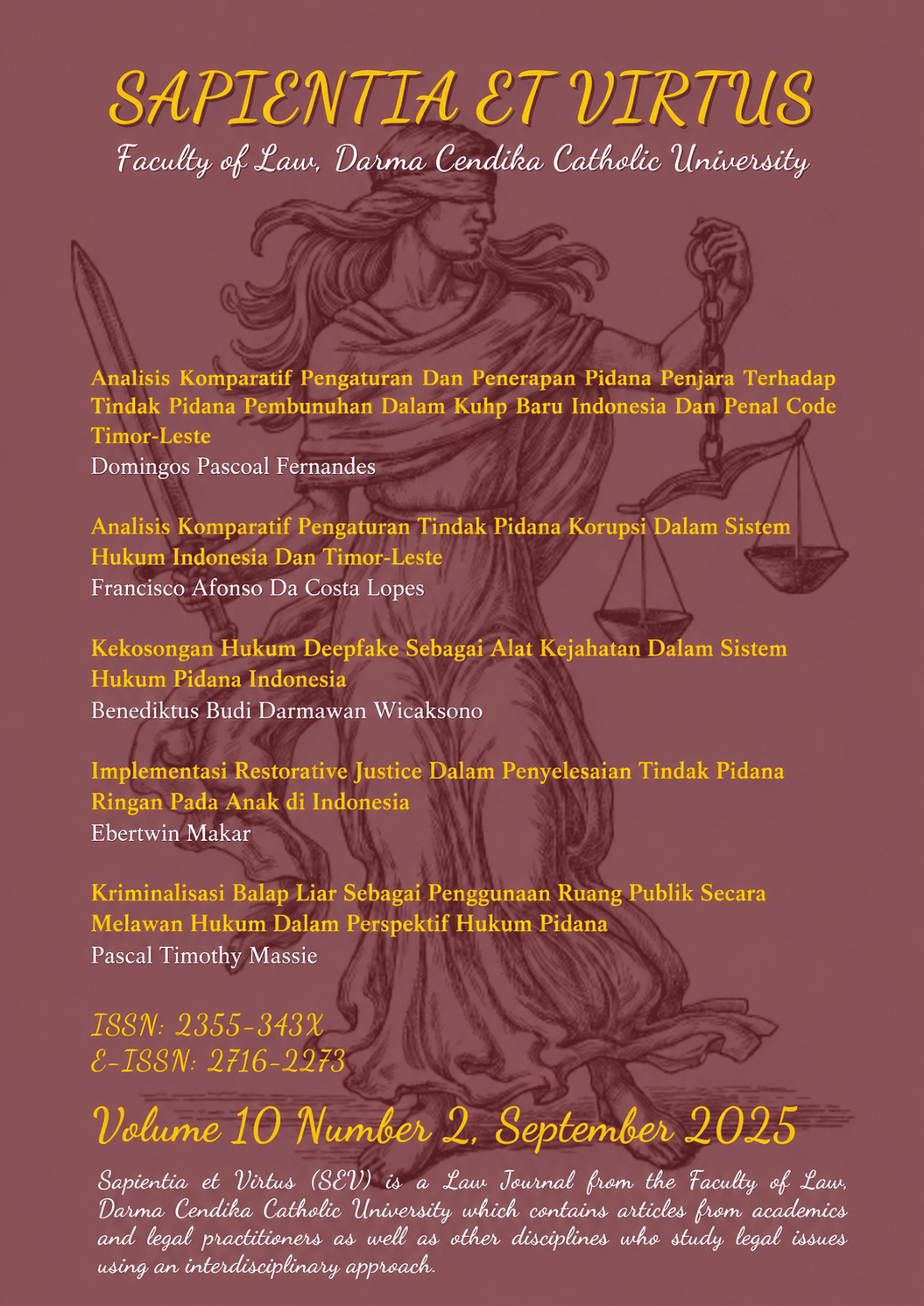
KEKOSONGAN HUKUM DEEPFAKE SEBAGAI ALAT KEJAHATAN DALAM SISTEM HUKUM PIDANA INDONESIA
DOI:
https://doi.org/10.37477/sev.v10i2.1022Keywords:
Deepfake, Legal gap, Criminal law, Artificial intelligence, CybercrimeAbstract
The rapid development of artificial intelligence has led to the emergence of deepfake technology, which enables the manipulation of images, audio, and video in a highly realistic manner. While this technology offers benefits in creative industries and education, it also poses significant risks when misused for criminal purposes, such as fraud, defamation, identity theft, and political disinformation. This study aims to analyze the adequacy of Indonesian positive law in regulating deepfake as a tool of crime and to identify the existing legal gaps. This research employs a normative legal method using statutory and conceptual approaches. The findings indicate that existing regulations have not explicitly addressed deepfake technology, resulting in reliance on general legal interpretations. Legal gaps are identified in the absence of clear definitions, lack of digital forensic standards, and unclear liability frameworks involving multiple actors. Therefore, legal reform is necessary to ensure legal certainty and effective protection for society against emerging digital crimes.
References
Jurnal
Buo, Shadrack Awah. n.d. “The Emerging Threats of Deepfake Attacks an Countermeasures.” https://doi.org/10.13140/RG.2.2.23089.81762.
Kietzmann, Jan, Linda W Lee, and Ian P Mccarthy. 2020. “Deepfakes : Trick or Treat ? Deepfakes : Trick or Treat ?” 63 (2): 135–46.
Mirsky, Yisroel, and Wenke Lee. 2020. “The Creation and Detection of Deepfakes : A Survey” 1 (1).
“No Title.” n.d.
Passos, Leandro A, Danilo Jodas, Kelton A P Costa, and Luis A Souza. n.d. “A Review of Deep Learning-Based Approaches For.”
Chesney, Robert, and Danielle Citron. 2019. “Deep Fakes: A Looming Challenge for Privacy,
Democracy, and National Security.” California Law Review 107: 1753–1820.
Kietzmann, J., et al. 2020. “Deepfakes: Trick or Treat?” Business Horizons 63: 135–146.
Citron, Danielle Keats. 2021. “Law’s Expressive Value in Combating Deepfake Harms.” Journal of Law and Technology: 44–60.
West, Matthew. 2020. “Synthetic Media and the Law.” Columbia Science and Technology Law Review: 1–30.
Calo, Ryan. 2017. “Artificial Intelligence Policy: A Primer.” UCLA Law Review 64: 399–435.
Buku
Soekanto, Soerjono, dan Sri Mamudji. 2004. Penelitian Hukum Normatif. Jakarta: PT RajaGrafindo Persada.
Amiruddin, dan Zainal Asikin. 2012. Pengantar Metode Penelitian Hukum. Jakarta: Raja Grafindo.
Moeljatno. 2008. Asas-Asas Hukum Pidana. Jakarta: Rineka Cipta.
Hamzah, Andi. 2017. Hukum Pidana Indonesia. Jakarta: Sinar Grafika.
Arief, Barda Nawawi. 2018. Masalah Penegakan Hukum dan Kebijakan Hukum Pidana. Jakarta: Kencana.
MacCormick, Neil. 1978. Legal Reasoning and Legal Theory. Oxford: Oxford University Press.
Kelsen, Hans. 1967. Pure Theory of Law. California: University of California Press.
Peraturan Perundang-Undangan
Undang-Undang Dasar Negara Republik Indonesia Tahun 1945.
Undang-Undang Nomor 11 Tahun 2008 tentang Informasi dan Transaksi Elektronik.
Undang-Undang Nomor 27 Tahun 2022 tentang Perlindungan Data Pribadi.
Kitab Undang-Undang Hukum Pidana.
Downloads
Published
How to Cite
Issue
Section
License

This work is licensed under a Creative Commons Attribution-NonCommercial 4.0 International License.